Symposium 2024: table displays

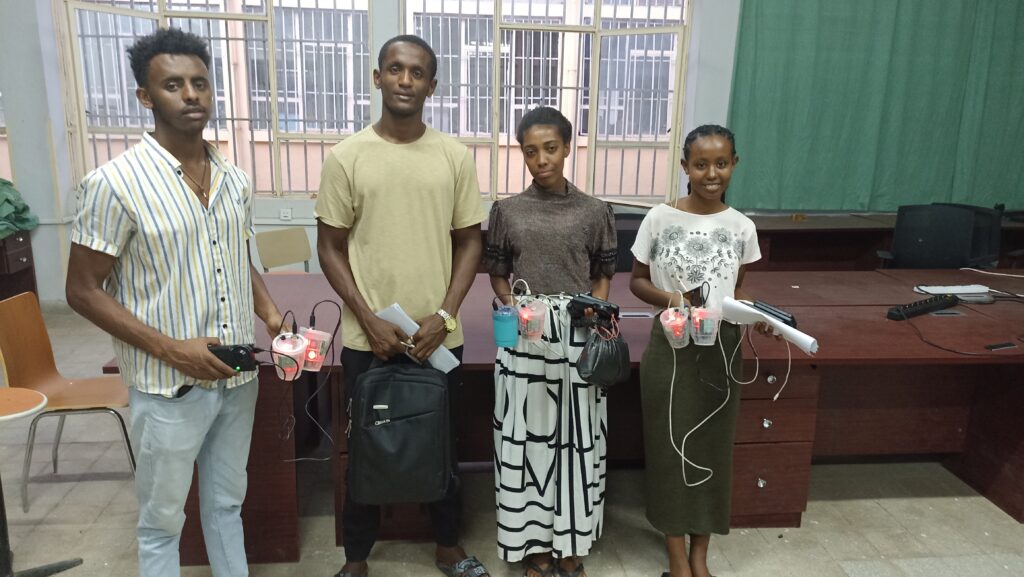
Arba Minch Water Technology Institute (AWTI) hosted the 22nd International Symposium on Sustainable Water Resources Development (June 14-15 2024). Together with four colleagues (Awel Haji, Demiso Daba, Edmealem Temesgen and Israel Gebresilasie), I organized table displays under the title ‘Do it yourself – Do it low-cost’.

Banner displayed at the 2024 international symposium

We could present low-cost sensor systems: the air pollution sensor, a soil moisture sensor system, and a water level sensor system. Materials were available for participants to try to make their own relative humidity and temperature sensor. Work of awtiCode (Python code development by and for AWTI staff) was presented as well.

41_IMG_20240614_090045
41_IMG_20240614_091047
41_IMG_20240614_091011
41_IMG_20240615_083430
41_IMG_20240615_095329
previous arrow
next arrow
41_IMG_20240614_090045
41_IMG_20240614_091047
41_IMG_20240614_091011
41_IMG_20240615_083430
41_IMG_20240615_095329
previous arrow
next arrow

For the symposium, we also created a poster presentation on the PM2.5 low-cost sensor system.

Poster presentation about low-cost sensor system at the 2024 international symposium. Click to download as PDF.

Student science call

We have opened a call for student science projects: Arba Minch University (AMU) staff is invited to propose plans for turning part of a course into a research project.

A call for university staff to submit plans for student science projects

Over the past five years, I have used an air pollution course to let students conduct research (student science). I strongly believe that the same can be applied in other fields. After presenting this idea to AMU top management, they agreed to support a pilot project, under which a maximum of ten student science projects across the university will run during academic year 2024/2025.

Memorandum of Understanding with Lund University

Arba Minch University and units of Lund University, Sweden, have signed a Memorandum of Understanding (MOU). From Lund, these are the Unit of Environment, Society and Health (Division of Occupational and Environmental Medicine) and the Unit of Ergonomics and Aerosol Technology (Department of Design Sciences). From Arba Minch University, this are the Arba Minch Water Technology Institute (of which I am part) and the School of Public Health.

I came into contact with representatives of Lund University through their co-organized international conference in Addis Ababa “Together for cleaner air in Ethiopia”. From how Lund University presented itself, and how I presented air quality work in Arba Minch, there is a mutual interest in cooperation on the field of air pollution. While the MOU is phrased in general terms, air pollution will be the initial field of cooperation.

Low cost measurement network proposal

Together with colleagues from various departments, I have created a proposal for establishing a low-cost measurement network with low-cost sensors and student science.

Over the past five years I have developed and tested a low-cost PM2.5 sensor system. I have used multiple courses to conduct research with students. Presumably, those two combined could result in a low-cost measurement network: sensor systems built and maintained by students, and data collected, validated, analyzed and interpreted by students as well. For this, I have joined hands with two colleagues from Environmental Health (Asmare Asrat and Awugchew Teshome), Geography and Environmental Sciences (Alemu Assele), Electrical and Computer Engineering (Afework Tademe), Meteorology and Hydrology (Israel Gebresilassie) and Water Supply and Environmental Engineering (Dagmawi Mateos and me). As staff, we will offer courses within our respective departments for which part of the content can be used to conduct tasks for the measurement network. For example, students of Electrical and Computer Engineering covering part of the course Microcomputer and interface by building the sensor systems. Or, Geography students covering part of a GIS course by spatially visualizing measurement network data.

The proposal is submitted as a thematic research to the Water Resources Research Center, and accepted on April 29 2024. Since budget is limited, we have submitted this proposal with a zero-budget: materials will be covered by my lab, while all labor will be done either by the students, or the staff offering those courses and supervising the students. Over the coming year we will find out whether the assumption (running a measurement network low-cost with low-cost sensors and student science is possible) is true or not.

See the presentation slides used during the proposal defense:

Low-cost research awareness meetings

Across two meetings, I met with institute and university staff and management to raise awareness for low-cost research opportunities. Over the past five years, both developing low-cost sensor systems and conducting research with students (student science) has given me access to many hours of data and some publications at little cost in the field of air pollution. I strongly believe that the same can be conducted in other fields.

At April 5, 2024, the meeting participants included lecturers and deans of the Arba Minch Water Technology Institute, as well as its scientific director (Dr. Bogale Gebremariam). With Dr. Tesfaye Habtemariam (Executive Director for Research of Arba Minch University) also joining us, we could have a fruitful discussion on opportunities and challenges with all layers of the university. This meeting was followed up with a meeting on April 11, 2024, where the university president (Dr. Damtew Darza), vice president of academics (Dr. Alemayehu Chufamo) and vice president of research (Behailu Merdekios) participated. Some of my students were present to show the instruments with which they conducted measurements. The locally developed soil-moisture sensor system was also on display.

Final year students of Water Supply and Environmental Engineering use locally assembled air pollution sensors.

The meetings raised awareness for low-cost research opportunities and integrating research with education. Below slides show the presentation and minutes of the challenges and solutions raised across the two meetings.

AirQo to host measurement data

AirQo has agreed to host our PM2.5 measurement data on their platform. AirQo started at Makere University (Uganda). It is currently the only builder of professional low-cost PM sensor systems in the African continent. I met them at the international conference “Together for cleaner air in Ethiopia” in Addis Ababa, December 2023. Their sensor systems provide real-time data, and this data is hosted on their platform. Over the past years, I have collected data at some locations in Arba Minch, and the coming year I plan to install fixed locations. Possibly I will include real-time data transmission on those measurement systems. However, AirQo also agreed to host historical data, based on CSV files I submit to them.

As a sample, I submitted historical data collected between April – May 2021. You can download it by visiting www.analytics.airqo.net. This proof of concept shows the future opportunity of locally constructing sensor systems in Arba Minch, installing them across Ethiopia, and openly sharing the data.

Successful import of components for fifty PM2.5 sensors

I am glad to share the successful import of components for fifty PM2.5 sensor systems. For the low-cost sensor systems, most items are available in Addis Ababa – but for a much higher price due to import restrictions. Last month, fifty pieces of all components were ordered in The Netherlands, and I was able to bring all these items into Ethiopia. For total costs of 2500 euro, and additionally 90,000 ETB of import tax, we have enough materials to construct more than fifty new measurement instruments. Considering that all measurements up to now have been conducted with approximately twenty systems, this is a huge increase of the measurement capacity.

Suitcase with materials for more than fifty sensors

A list of all materials, with links to the sellers:

Donation of sensors for collaboration with Debre Birhan and Addis Ababa

Professor Solomon Bililign of the North Carolina Agricultural and Technical State University has made a donation of 30 SPS30 Sensirion sensors to Addis Ababa University, Arba Minch University and Debre Berhan University. With these sensors as input, teams at Addis Ababa University and Debre Berhan University can start building sensor systems following my designs (and hopefully improving on it).

Sensirion SPS30 PM sensor

In December 2023 I presented my work on low-cost sensor system development and student science at the ‘Together for cleaner air in Ethiopia’ international conference in Addis Ababa. Based on this, Professor Solomon decided to fund components for additional sensor systems. The Sensirion SPS30 is not available in Ethiopia, and is therefore the primary candidate for funding. All other components, albeit at higher prices, are available in Ethiopia. The university teams will provide those components themselves.

Low cost soil moisture sensor

A team of Arba Minch Water Technology Institute (AWTI) has assembled a soil moisture sensor system with arduino and micro-electronics. Last summer, I was able to bring five soil moisture capacitance sensors from The Netherlands. Demiso Daba, Tafesse Fitensa and Getachew Enssa followed the one-day Arduino workshop. A PhD student (Edmealem Temesgen) and MSc student (Chanako Dane) from the faculty of Irrigation became also involved, as the availability of measurement instruments makes it possible for them to collect primary data for their research.

Field installation
Field measurements
Soil moisture system inside
Soil moisture system outside
previous arrow
next arrow
Field installation
Field measurements
Soil moisture system inside
Soil moisture system outside
previous arrow
next arrow

As part of his PhD study, Edmealem Temesgen conducts field comparisons between the sensor system and the laboratory volumetric method for soil moisture tests. The first results are very promising, see below figure.

Preliminary results of a comparison between volumetric method and sensor system soil moisture field measurements. Results currently under publication.

Article on road-side measurements

The Ethiopian Journal of Water Science and Technology (EJWST) has published an article by me and my students titled “Roadside PM2.5 concentrations measured with low-cost sensors and student science in Arba Minch, Ethiopia“. During April and May 2022, students of Water Supply and Environmental Engineering, year 3, conducted PM2.5 measurements at road-side locations. They did so with the locally assembled sensor system, as part of the course Air and Noise pollution. In this way, seven groups of 5-6 students collected approximately 2,500 hours of PM2.5 data. After the course, I analyzed the data and turned it into a manuscript. Two of the students (Mekdes Dawit and Tewodros Zerihun) provided valuable feedback and became co-authors to the article.

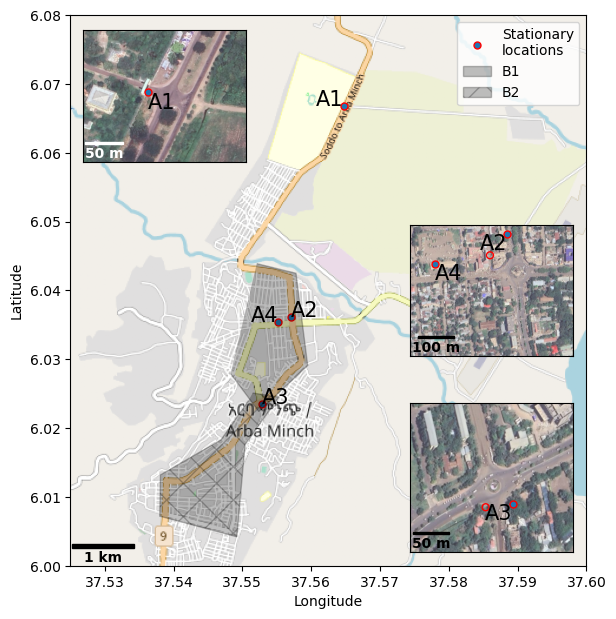
Students conducted measurements at six locations: four stationary and two mobile locations (Figure 1 in the article).

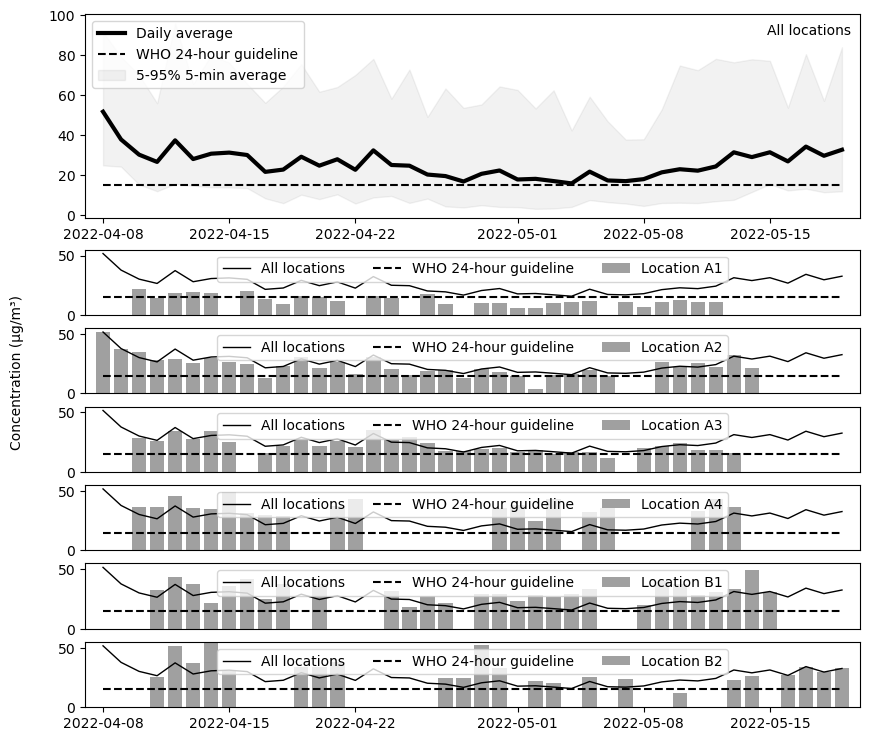
Measurements were conducted at six locations: one at the university campus gate, two at busy squares, one at the bus station, and two inside public transport tuktuks (bajaj). Except for the campus gate, at all locations concentrations exceeded WHO guideline values. Highest concentrations were observed during the morning period at the bus station. Supporting data and data processing code is shared on an OSF repository.

PM2.5 concentrations measured at six locations, in contrast with the WHO guideline (Figure 3 in the article).

Low-cost sensors and student science

The article is a showcase of the application of both locally assembled low-cost sensors and student science. Combined, these methods provided me with a lot of data for very little costs. At the same time it provided my students with practical experience as part of a course. During the course Air and Noise pollution, they got lectures on the course contents. They had to apply this knowledge by selecting a specific research question, constructing measurement plans, installing and operating the instruments, processing the data in Microsoft Excel, and writing a report.