Posts

Article on low-cost sensor system

Over the past four years, I have built a low-cost particulate matter (PM) sensor system from scratch, and tested it under various situations in Ethiopia. Together with Afework Tademe, a colleague from Electrical and Computer Engineering, I have written an article on this low-cost sensor system, which is now published by the Clean Air Journal.
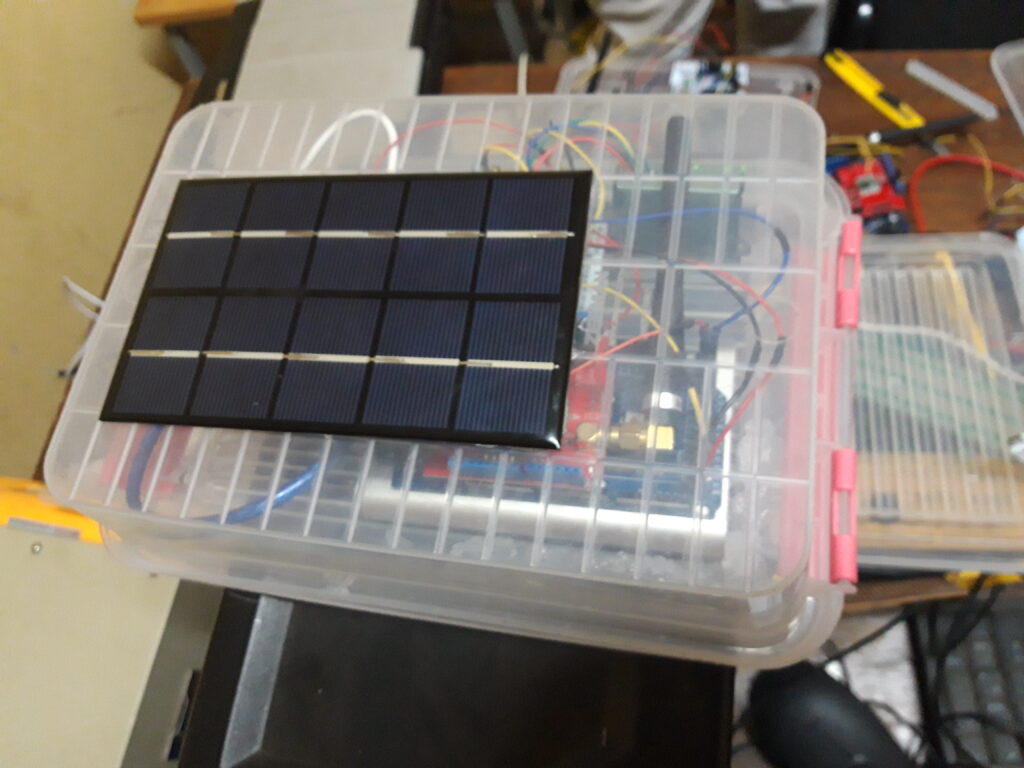
One of the locally assembled low-cost particulate matter sensor systems.

The publication covers use of the sensor system across fourteen locations for more than 30,000 hours combined. In the publication, we openly share the system design. All data and materials supporting the publication are available in an OSF repository. We also show results of data quality validations. These validations included collocation of multiple sensors and gravimetric measurements.

It is not our intent to create and share the best sensor system. Rather, we want to show that a sensor system can be built locally, with two main benefits: lower costs and local experience training. Furthermore, we fill a gap in local validation of low-cost sensors. Several types of low-cost sensors are being used on the African continent. However, field validation under circumstances common to a country like Ethiopia are extremely limited. Up to my knowledge, we are the first to share validation of the Sensirion SPS30 with gravimetric measurements under high concentrations (inside kitchens with biomass fuel) and ambient concentrations in Ethiopia – or even Africa. Or, more correctly, we fill part of the gap. I want to add (much) more validation measurements. Some of this is ongoing. Currently, an MSc student compares my sensor systems with gravimetric measurements in Addis Ababa and Adama.

International conference air quality Addis Ababa

Lund university (Sweden), Haramaya University, Institutes of Geophysics, Space Science and Astronomy of Addis Ababa University, and the Department of Physics of North Carolina A&T State University co-organized the international conference ‘Together for cleaner air in Ethiopia’ (18-20 December 2023). I was offered the opportunity to give two presentations about the work at Arba Minch University: locally developing the low-cost sensor system, and conducting research with students (student science).

Participants of the ‘Together for cleaner air in Ethiopia’ workshop

Slides of the low-cost sensor system presentation:

Slides of the student science presentation:

Seminar on low-cost research

Research budget in Ethiopia is extremely limited, and many of my colleagues are not involved in research due to that. The Water Resources Research Centre organized a seminar on conducting low-cost research at December 4, 2023. I presented from own experience on ‘How to collect +25,000 hours of data and create five scientific articles with almost no budget’. This included sharing my work on low-cost sensor development and conducting research with students. After presenting my experiences, we had an interactive session with the twenty attendants on what opportunities and challenges there are for low-cost research.

Arrival of LVS Leckel reference instrument

With help of Buro Blauw B.V., a PM2.5 reference measurement instrument has arrived in Arba Minch: a Leckel Low Volume Sampler (LVS).

Leckel Low Volume Sampler: reference instrument for PM sampling

The LVS is a NEN-12341 certified instrument for sampling PM2.5. It is the first of its kind in Ethiopia. With a constant flowrate of 2.3 m3/hour, it draws air through a filter. PM2.5 is captured by the filter. By weighing the filter weight before and after the measurement, the precise amount of PM2.5 in the sampled air volume is known. I can use this instrument to validate (and calibrate) PM2.5 low-cost sensor systems.

Training by awtiCode

Some months ago, we launched the awtiCode core team. Now, awtiCode has offered its first Python training: Basic Python for Environmental Dataprocessing. In previous years I gave Python trainings to colleagues of the Arba Minch Water Technology Institute (AWTI). I am very happy that from these trainings and the launch of awtiCode, through awtiCode colleagues have now stood up to offer the training by themselves. The training was fully offered by Awel Haji, Bahafta Gebresilassie, Beyene Senedu, Demiso Daba and Israel Gebresilasie.

Python training practice
Certificates
Python training
previous arrow
next arrow

Approximately twenty participants followed the training, divided over two separate groups. The training focused on the use of Python for Environmental Data Processing. It moved from the very basics (variables, collections, functions) to applied topics (satellite data, visualizing data on a map). In total, the training took five weeks of two full mornings per week. Training materials were earlier created by Nimrod de Wit, and slightly revised by the trainers. You can find all training materials on my GitHub repository.

Validation measurements in Addis Ababa and Adama

Wegene Negese, an MSc student at Arba Minch University (Climate) and employee of the Ethiopian Meteorology Institute (EMI), has conducted validation measurements of the low-cost sensor system with SPS30 Sensirion at the EMI meteorological stations of Addis Ababa and Adama. For a period of four months, he collocated the sensor system with itself, and conducted gravimetry measurements. Gravimetry is the reference method for calibrating PM2.5 measurement instruments.

He is currently working on his MSc thesis, but I can already present some preliminary results:

  • The coefficient of variation (CV; a measure of variation between two identical instruments) was 9.5% for two sensor systems in Addis Ababa (based on 12,677 10-minute averages), and 4.4% for two sensor systems in Adama (based on 4,135 10-minute averages). This indicates that the variation between two sensor systems is lower than 10%. 10% is set as a maximum allowed CV for measurement instruments by the NIOSH and the US EPA.
  • The sensor system systematically measures lower than gravimetry, but the correlation is strong. Linear regression of all data points of Addis Ababa and Adama combined (n=16) leads to a slope of 1.62 with an R2 of 0.99. The Pearson correlation is 0.97.

The data of Wegene confirms wat I found in earlier data with measurements in Arba Minch: the SPS30 Sensirion has low within-variation, and shows a stable bias both under ambient and indoor (high) concentration settings versus gravimetry measurements (see this publication). In other words: the SPS30 Sensirion appears to be a very good sensor under Ethiopian circumstances.

Arduino workshop sensor systems

Together with my colleague Afework Tademe (electronics) I organized a one-day Arduino workshop, in order to help colleagues get started with building their own low-cost sensor systems. Five colleagues got a crash-course in microprocessors, sensors and electronics. As part of the program, participants built themselves working systems of relative humidity and temperature sensors, LEDs and real-time clocks. Hopefully we will see a variety of locally developed low-cost sensor systems!

Arduino class
Microelectronics
Arduino build
previous arrow
next arrow
Background

Last June, I presented my work at the international symposium of my institute. That raised the question on whether the same principle (buying microelectronics and locally constructing sensor systems) could be used for the field of water- and soil studies. Over the summer I was able to bring to Ethiopia cheap soil moisture, water level and water temperature sensors. The one-day Arduino workshop on building sensor systems is meant to motivate colleagues to start building their own low-cost instruments.

Below you can see the slides used during the workshop.


Presentation at 2023 international symposium

I presented my work on low-cost research methods at the 21st International Symposium on Sustainable Water Resources Development (June 9-10, 2023). This symposium is organized by my institute (Arba Minch Water Technology Institute) and the Water Resources Research Center (WRRC).

Arba Minch University faced budget cuts, which reduces opportunities for local staff to conduct research. Reducing research costs expands research opportunities at this time, because many staff members are idle. Therefore, my focus on low cost research by using Do-It-Yourself (DIY) measurement setups and students as data collectors (student science) caught the attention of the research director of the WRRC. He invited me to present about these two cost-saving methods on the symposium. See here the slides of the presentation.

Apart from presenting, I could display different instruments on tables. I showed all components that go into the low-cost PM2.5 sensor system. Participants could try to register the highest CO2 concentration by blowing into an CO2 measurement instrument. Also, the recently launched awtiCode was on display, and participants could leave suggestions and questions for Python code.

Table presentation
LCS parts
CO2 competition
awtiCode
previous arrow
next arrow

DOI for Arba Minch University journals

Thanks to the Global Equitable Membership (GEM) program of Crossref, all journals published by Arba Minch University (AMU) now have DOI registration. AMU publishes the following journals:

Until recently, these journals did not have DOI registration. I came across the Crossref GEM program, and through this program Crossref has provided Arba Minch University with DOI registration capacities for free. Through DOI registration, articles published in these journals will be found more easily through platforms like Google Scholar, which can lead to more citations and higher scientific impact.


[UPDATED] Two of my articles are published in the EJWST, and thanks to Crossref now have permanent DOI links:

Launching awtiCode

Together with colleagues from the Arba Minch Water Technology Institute (AWTI), I have launched awtiCode: Python code by and for AWTI staff. With a core team, we are planning bi-weekly meetings, where progress and plans are discussed. We will inquire dataprocessing needs amongst colleagues, and (try to) code solutions. Code is hosted on GitHub repositories: /jddingemanse/awticode and /awticode.

Current members of the awtiCode core team are Awel Haji, Bahafta Gebresilassie, Beyene Senedu, Daniel Asele, Demiso Daba, Israel Gebresilasie, Mesele Markos and Nebiyu Waliyi. The launch of awtiCode is another step in promoting Python dataprocessing in my institute. I have given various trainings, such as a Basic Python training (see here and here), and a Training of Trainers. True programming skills, however, come from doing. The assumption is that awtiCode will result in coding experience for the core members.