Presentation at 2023 international symposium

I presented my work on low-cost research methods at the 21st International Symposium on Sustainable Water Resources Development (June 9-10, 2023). This symposium is organized by my institute (Arba Minch Water Technology Institute) and the Water Resources Research Center (WRRC).

Arba Minch University faced budget cuts, which reduces opportunities for local staff to conduct research. Reducing research costs expands research opportunities at this time, because many staff members are idle. Therefore, my focus on low cost research by using Do-It-Yourself (DIY) measurement setups and students as data collectors (student science) caught the attention of the research director of the WRRC. He invited me to present about these two cost-saving methods on the symposium. See here the slides of the presentation.

Apart from presenting, I could display different instruments on tables. I showed all components that go into the low-cost PM2.5 sensor system. Participants could try to register the highest CO2 concentration by blowing into an CO2 measurement instrument. Also, the recently launched awtiCode was on display, and participants could leave suggestions and questions for Python code.

Table presentation
LCS parts
CO2 competition
awtiCode
previous arrow
next arrow

Students find priority areas: publication

The student course on air quality in 2019 resulted in concentration data of various places on the campus of Arba Minch University. Together with three top students of this cohort (Muse Abayneh, Kirubel Getachew and Feyera Fekadu) I wrote an article concerning priority areas that could be distinguished from the student measurements. This article has now been published in the Clean Air Journal: Using student science to identify research priority areas for air pollution in a university environment: an Ethiopian case study.

Student measurements at various locations, relative to the respective guideline value. At multiple locations measurements are above the guideline value (>100%).

Article on student science

Aquademia published our article titled An Evaluation of Best Practices in an Air Quality Student Science Project in Ethiopia.

The publication is based on my students’ data from October 2019 – January 2020. We evaluated this practical course’s educational and scientific outcomes to see if combining research and teaching is feasible in Ethiopia’s public university context. Spoiler: it is.

Figure 1 of the publication: comparison of student measurements with other studies, across various scenarios. Measurements by my students are in most cases comparable to other studies.

We speak about ‘student science’ to keep a strong link with ‘citizen science’ (science done by non-scientists), but to stress that it is with students. The benefit of this approach is that, contrary to other citizens, university students are supposed to learn about doing research. Therefore, involving students in conducting research has both benefits for the research field and for the students’ education. I am planning to keep applying this method, and I hope that others at Ethiopian universities will start applying it as well. In a country with both theoretical education and limited research resources, student science is a win-win.

Air pollution course 2021

The first semester of academic year 2019/2020 I offered two air pollution courses, in which 33 groups of students collected air pollution data. The corona outbreak upended the academic calendar, so that this year’s air pollution course for year 4 Water Supply and Environmental Engineering students became scheduled from April 2021 instead of October 2020. This year’s batch was three sections, with a total of 101 students. One of the lessons of previous round was a lack of time. While a full research project requires due attention for all parts of the research cycle (from formulating research questions all the way to presenting findings), it is challenging to squeeze that into a single course. Therefore, for this year I decided to cooperate with my colleague (Bewketu Aweke), who would offer the course Research Methods to the same batch. From his course, he could cover research methodology, and from my course, I could cover air pollution. The students would conduct one research project that would be assessed for both courses.

Condensed course outline

An oncoming election upended a well-constructed schedule. In the first week of the course, we were informed that there would be six instead of the usual 12-15 weeks available. Students would be sent home after six weeks, and only come back a month later for conducting a final exam. We let the students execute a condensed form of the project, with the following outline:

  • Week 1: topic and instrument introduction, start on proposals;
  • Week 2: deadline of proposals.
  • Weeks 3-4: data collection.
  • Week 5: Data analysis.
  • Week 6: Draft report. Based on feedback on the draft report, students could submit a final report some weeks later.

Simultaneous to the project activities across these weeks, there were the course lectures of the two courses. These lectures covered the theoretical course contents, but also provided input for the project activities. In total 21 groups of students conducted measurements of PM2.5, CO and/or CO2 at self-selected locations on or around campus.

Individual assignment

Apart from time limitation, a lesson of the earlier project was that with group work, it was difficult to let all students participate equally. This year, all students were sent to their hometown after six weeks. This provided a unique opportunity to let students individually apply what their group found during the measurements. Every student got the individual assignment to interpret their groups’ measurement for their hometown situation. This resulted in 101 students thinking about their family members or neighbors that might encounter situations in which they had conducted measurements. For example, a group member that measured during coffee preparation:

We measured an average concentration of 288 microgram/m3 PM2.5 during preparation of coffee ceremony at the campus coffee place. In my hometown we have coffee ceremony. My mom spends three hours of the day in coffee preparation. If my mom is exposed for three hours to a concentration of 288 μg/m3, her 24-hour average will be at least 3*288/24 = 36 μg/m3. Likely, it will be higher, because during the other 21 hours of the day she also cooks food for us. So, her average exposure is most likely higher than the standard of 25 μg/m3. I recommend to my mom to use electric stove.

Or, a group member that conducted measurements close to waste burning:

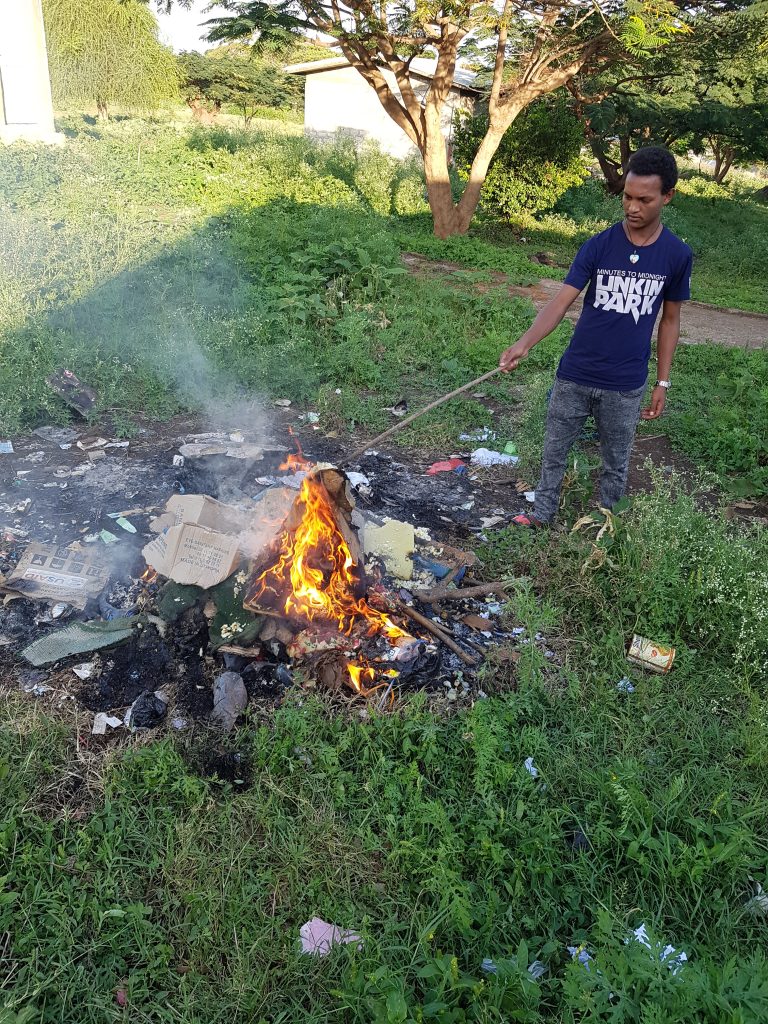
We measured for 51 minutes while waste was burning. We measured an average concentration of 874 μg/m3. My sister works as a waste collector. She works probably for about two hours per day close to waste burning. If she is exposed for two hours to a concentration of 874 μg/m3, then her 24-hour average exposure will be at least 2*874/24 = 72.83 μg/m3. I recommend that the community reduces waste, and that instead of burning it, they use other waste disposal methods. My sister needs to be careful, wear a mask and stay far away from burning waste.

Air pollution courses 2019

From October 2019 – January 2020 I offered two air pollution courses to four sections of students. I offered the course Air, Noise and Soil pollution to year 4 Water Supply and Environmental Engineering students (three sections; 150 students). I offered the course Atmospheric Chemistry and Air Pollution to year 2 Meteorology and Hydrology students (29 students). For both courses, I used 50% for student air pollution research projects. 33 groups studied a self-selected topic with respect to PM2.5, CO and/or CO2 concentrations on or around campus. They collected a combined 17,431 data points across various scenarios.

Course outline

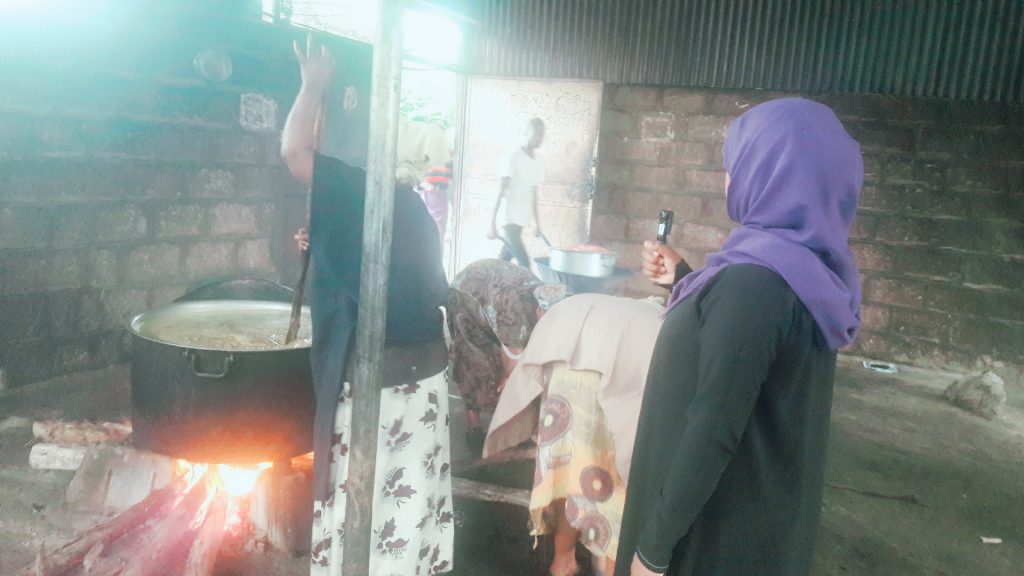
I spread out the courses over approximately 12 weeks. I used fifty percent of the course time for ‘normal’ course contents: lectures on seven chapters, tests, and a written exam. Those activities were spread out over the whole semester. Simultaneously, the students used the other fifty percent for various parts of research projects. The first four weeks, students (with knowledge from the first lectures) selected topics and worked on a measurement plan. The students chose topics like ‘CO2 concentration in and outside a dormitory’, ‘CO concentration in a kitchen during cooking’, ‘PM concentration close to a generator’, etcetera.

Part of the measurement plan was to select measurement instruments and measurement times. In total I had 6 Lascar El-USB-CO, 6 UCB-PATS+, and 6 IQ Air Airvisual Pro instruments available. Students could select the instruments and use them across a period of four weeks. Between weeks 8-11, students analyzed their data and wrote a report. In the final week, all groups gave a small presentation on their research project.

Research and experience

This project was new for the students. Most courses are theory-based and lecture oriented. While uncertain at the start, students clearly liked the challenge and the opportunity to study air pollution themselves rather than only learn about it from lectures. On beforehand, colleagues warned me about giving instruments to students. However, the students rewarded me with their motivation for the trust I put in them. They returned all instruments in good working order. I am glad the instruments were put to good use, rather than only being on display. The students’ work gave me access to air pollution measurements across various scenarios – with some very high concentrations. I am planning to analyze the data of the students combined, and most likely will apply this teaching method in my future courses as well.

[UPDATE]: data collected by the students during these courses have been the basis for two publications:

For the second publication, three students from the courses were co-authors.

Students measure high concentrations

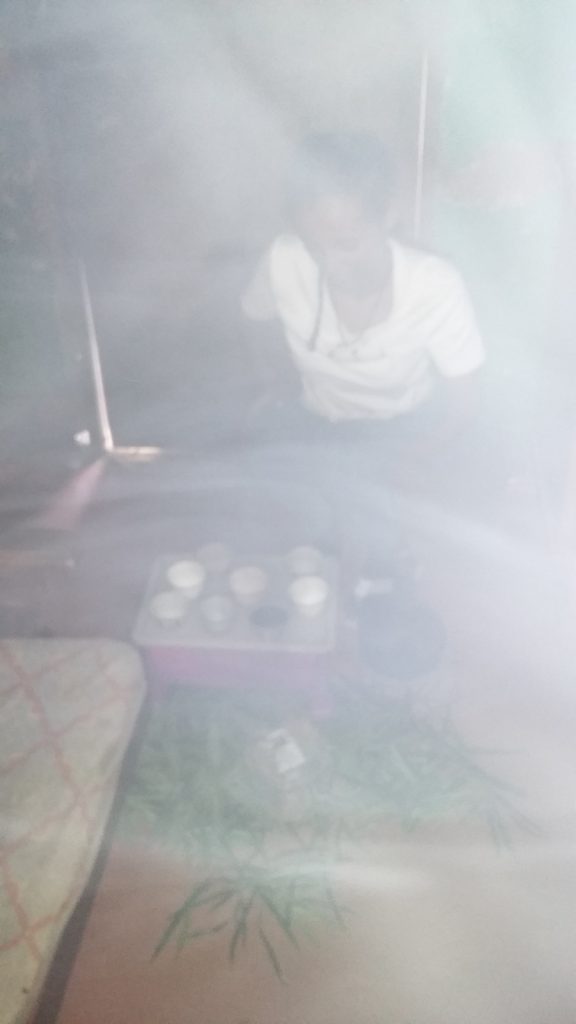
Outdoor concentrations of PM2.5, CO and CO2 are generally about 10 μg/m3, 0.3 PPM and 450 PPM, respectively. However, close to air pollution sources and/or with circumstances of little ventilation, concentrations can be much higher. This is also witnessed by students of Arba Minch University. So far, they have set records of measured concentrations at 1,800 μg/m3 PM2.5 ( coffee ceremony) 1,040 PPM CO (student’s cafeteria kitchen) and 4.200 PPM CO2 (a closed dormitory with students present).

A student measuring PM2.5 during coffee ceremony

The measurements

33 groups of students from Arba Minch University (Bachelor studies Meteorology & Hydrology, year 2, and Water Supply & Environmental Engineering, year 4) are conducting a small air pollution measurement research.