
Conventional air quality measurement instruments are expensive, but nowadays low-cost sensors are widely available. For measurements of particulate matter (PM), low-cost sensors give relatively good results. There are several commercial low-cost sensor systems available, but it is also possible to buy a separate sensor from a manufacturer (Original Equipment Manufacturer, OEM), and add components from microelectronics to make a working sensor system. This results both in cost reduction as well as opportunities for local developers.
I have brought components and the OEM Sensirion SPS30 to Arba Minch to create a PM sensor system. Colleagues from the faculty of Electrical and Computer Engineering have assembled sensor systems with these components. I test and use these sensor systems with students and colleagues across Ethiopia. In publications on this system, we call it the SPSA: SPS30 with Arduino microprocessor.
Components
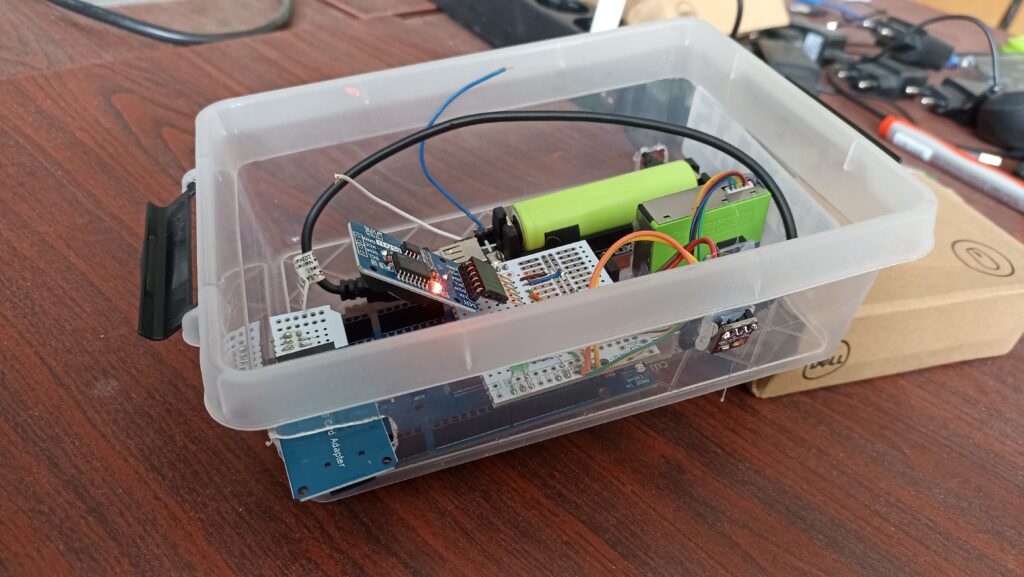
The core of the SPSA is the Sensirion SPS30 PM sensor. We connect it to an Arduino microprocessor to get the readings. A real time clock module (DS3231) is included to keep track of time, and an SD module for a micro SD card is included for local storage.
The SPSA system is ultimately a Do-It-Yourself system: we have combined multiple microelectronic components to build a sensor system, and likewise anyone else can do it. This also means it can be changed according to interest. On some systems, we have included a BME280 sensor for relative humidity and temperature, and a LoRaWAN shield for data transmission. We could also add GPS, WiFi, 4G, or other sensor units. If I find out that another OEM is on the market that is much better than the Sensirion SPS30, we could also switch from PM sensor. The objective is not to build a standardized best sensor system (I am not a sensor company). Instead, I want to make reliable air quality data collection accessible for low-resource communities, and I want to train expertise of building and using instruments within such communities.
On this page you can find an overview of the SPSA components and their prices.
Works
A list of public works with low-cost sensors:
- Publication “Evaluation of three low-cost particulate matter (PM2.5) sensors for ambient and high exposure conditions in Arba Minch, Ethiopia”. A comparison of the IQAir Airvisual Pro, UCB-Pats+ and Sensirion SPS30.
- All underlying data and data processing code on an OSF repository
- Publication “Developing and testing a PM2.5 low-cost sensor in Ethiopia under ambient and indoor air pollution conditions”. A description of the SPSA and its data quality.
- All underlying data and data processing code on an OSF repository
- Publication “Roadside PM2.5 concentrations measured with low-cost sensors and student science in Arba Minch, Ethiopia”. Students used the SPSA to monitor PM2.5 concentrations on and next to roads in Arba Minch.
- All underlying data and data processing code on an OSF repository
- Presentation “Local development and quality testing of a low-cost PM2.5 sensor system” at the 18-20 December 2023 Workshop ‘Together for cleaner air in Ethiopia, an international conference in Addis Ababa.
- Presentation “Opportunities for research and education in a low-resource context: air pollution research as showcase” on the June 9-10 2023 Symposium on Sustainable Water Resources Development, at Arba Minch University.
- Poster presentation “Evaluating the quality of a locally-developed PM2.5 sensor system under Ethiopian ambient and indoor air quality circumstances”. Displayed at the June 14-15 2024 Symposium on Sustainable Water Resources Development, at Arba Minch University. The poster includes data of a publication, as well as data collected by an MSc student (Wegene Negese) and as of yet unpublished.
Click here for all posts regarding low-cost sensors.
Related work
I have brought some water- and soil quality sensor components to Arba Minch as well, hoping that colleagues of the Arba Minch Water Technology Institute will follow my example and start building and testing their own sensor systems. Some colleagues have been testing a soil moisture sensor system.